
January 25, 2026 |
Selling a property and buying an under construction apartment? Timing is key to save capital gains tax
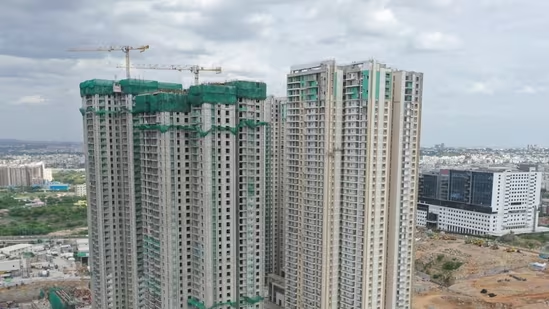
If you sell an apartment and plan to reinvest the proceeds in an under-construction property, delays in project completion beyond three years could jeopardise your long-term capital gains (LTCG) exemption under Section 54. Homebuyers reinvesting sale proceeds risk losing the tax benefit if construction timelines exceed the stipulated period, making timely completion critical.
Surat-based Kamal Mehta sold a residential property and booked an under-construction flat to claim capital gains exemption under Section 54. Although the project was registered under RERA, the purchase agreement mentioned a scheduled completion date extending beyond three years from the date of sale. Recognising the risk this posed to his tax planning, Mehta did not rely solely on the project timeline. Instead, he invested part of his capital gains in Section 54EC bonds issued by NHAI within the stipulated period, while parking the remaining amount in the Capital Gains Account Scheme.
The scheduled completion date in the agreement is therefore critical, and investors should factor in possible construction delays to protect their long-term capital gains exemption.
The scheduled completion date matters
“When the capital gain is made and the assessee wishes to purchase a new flat, then it is very important that the assessee should select a flat that is likely to be completed within the period of three years, and it is very essential that the agreement for purchase states that the scheduled date of completion is within that period of three years,” says Anil Harish, Partner, D.M. Harish & Co.
Investors should note that if the agreement itself specifies a scheduled completion date beyond three years from the date of capital gains, even a delay by the developer would not help the assessee, as the project would remain outside the prescribed period even if completed as per schedule.
“Developers are now required by RERA to specify the date for completion. In certain circumstances the developer can apply for an extension and justify that request,” says Harish.
Therefore, investors should not take the date of completion for granted, especially if they want to invest his or her sale proceeds or capital gains under section 54F or under section 54.
The assessee must be conscious of the provisions of law and strict interpretation thereof and must plan accordingly. “If it happens that the developer is genuinely delayed and takes an extension from the authorities, then the assessee may succeed in saying that the fault was not his but that it was that of the developer, and may get the benefit,” says Harish.
Plan for construction delays
However, if an under-construction property is not ready within three years, investors could explore legitimate strategies or alternative reinvestments to potentially preserve LTCG exemption benefits.
If delays are anticipated soon after selling the asset, investors can explore exemptions under other sections, such as Section 54EC bonds (NHAI or REC), which provide a risk-free exemption of up to ₹50 lakh.
“If that window has passed, another option is to purchase a different ready-to-move-in property within two years of your sale, provided you still meet the “one house” ownership limit. Throughout this process, one must ensure all unutilised funds are parked in the Capital Gains Account Scheme (CGAS), which is vital to prove your bona fide intent to the tax authorities,” says Ritika Nayyar, Partner, Singhania & Co.
Maintain all property documents
One must maintain proper documentation such as legal acquisition or completion documents of the property rather than just payment dates. For purchases, one must retain the registered sale deed and possession letter. In case of construction, the Completion Certificate is the most important proof for the three-year timeline.
Additionally, one must maintain bank statements, Capital Gains Accounts Scheme passbooks, to link your capital gains on the investment. “If formal certificates are delayed, support your claim with utility bills, a property tax receipt, or a valuation report to prove the house is ready to move in and live in,” says Nayyar.
Careful planning, awareness of completion timelines, and maintaining proper documentation are crucial for preserving long-term capital gains exemptions. Alternative strategies like Section 54EC bonds or ready-to-move properties help investors safeguard tax benefits despite construction delays.
Source – Hindustan Times
Related Articles
VKS Palm Drive Sector 3 Pataudi – Premium DDJAY Plots in a Gated Township
VKS Palm Drive is a well-designed residential plotted development in the new area, a Sector 3 Pataudi, locality. It is […]

Pareena Aangan Sector 14 Sohna: Build Your Dream Home Near Gurgaon
Pareena aangan sector 14 Sohna is well planned residential plotted development in which modern lifestyle will be given besides the […]

From Golf Course Road to Dwarka Expressway: Inside Gurugram’s Rs 10 crore+ luxury housing boom
Gurugram has become India’s fastest-growing high-end residential market after achieving sales of homes worth Rs 10 crore and above, which reached […]